(AfriquePlus) - As eastern Congo's front lines buckle and an Ebola outbreak becomes the deadliest in the country's history, President Félix Tshisekedi has spent recent months attending football matches abroad while his government struggles to fund the response to both crises, according to reporting published in Africa Unscrambled by Phillip van Niekerk and Francois Misser.
The publication reports that American mercenary financier Erik Prince, founder of Blackwater, was seen in Kinshasa attending a strategy session with Tshisekedi's inner circle on the eastern war, a conflict that, by most accounts cited in the piece, is going badly for the government. His Salvadoran fighters deployed in Bujumbura and South Kivu reportedly withdrew once Ebola hit the region, though contractors from his firm Vectus Global remain at mining sites further south in Katanga.
Drone warfare has become decisive on the battlefield, and according to the report, momentum has shifted to the Rwanda-backed M23 and the Congo River Alliance (CRA). Three weeks before publication, the Twirwaneho militia — Banyamulenge Tutsi fighters allied with the coalition — used drone swarms to rout Burundian troops on the Itombwe highlands, seizing the strategic position of Point Zero near Minembwe. The coalition, the article notes, now operates a layered air-defense network over Minembwe, Goma and Bukavu built from Estonian reconnaissance drones, modified commercial drones and Turkish Bayraktar TB2s.
The stakes of that advance are stark. One businessman operating in the DRC, quoted in the piece, warned that if Rwandan or M23 forces pushed toward Kalemie and opened the road to Lubumbashi, "that would be the end of Congo" and Tshisekedi "would be out of power." Van Niekerk and Misser note, however, that Rwandan President Paul Kagame appears reluctant to force that outcome outright, given how much foreign capital — American, Chinese, Emirati, Indian — is now invested in Katanga's mines; Kigali, they suggest, may prefer to let the province rise up on its own.
The report describes growing anger in Katanga over mining revenue flowing to Tshisekedi's own relatives, chiefly his brothers, with political posts across the region dominated by his Sacred Union coalition. Yet the opposition remains divided: relations between former president Joseph Kabila — sentenced to death in absentia and reportedly now residing part-time in rebel-held Goma — and Katanga's Moïse Katumbi are described as strained, with Katumbi seen by analysts cited in the piece as lacking a "killer instinct" despite his popularity.
Minerals, mercenaries and a stalled peace deal
The peace accord signed by Tshisekedi and Kagame at the White House on December 4 has produced little beyond paper commitments, the article states, despite requiring a 90-day Rwandan troop withdrawal. Kinshasa's late-July memorandum with the FDLR militia was dismissed by Rwanda as a delaying tactic; the article quotes Rwandan Foreign Minister Olivier Nduhungirehe describing it as a pact between "the Father," "the Son" and "the Evil Spirit."
Washington's mineral diplomacy has yielded mixed results. Van Niekerk and Misser detail a $700 million purchase of the Etoile and Mutoshi copper-cobalt mines by Virtus Minerals, a firm founded by retired US military and intelligence officials, while the bulk of Congolese output continues flowing to China, underscored by Manono Lithium's first shipment, majority-owned by China's Zijin Mining, routed through Tanzania rather than the US-backed Lobito corridor. A separate $9 billion deal for a stake in Glencore's Katanga operations remains stalled, complicated by unresolved royalty claims from sanctioned Israeli businessman Dan Gertler, a striking detail given, as the report points out, that Glencore previously pleaded guilty in the US to bribing Congolese officials to acquire those same assets.
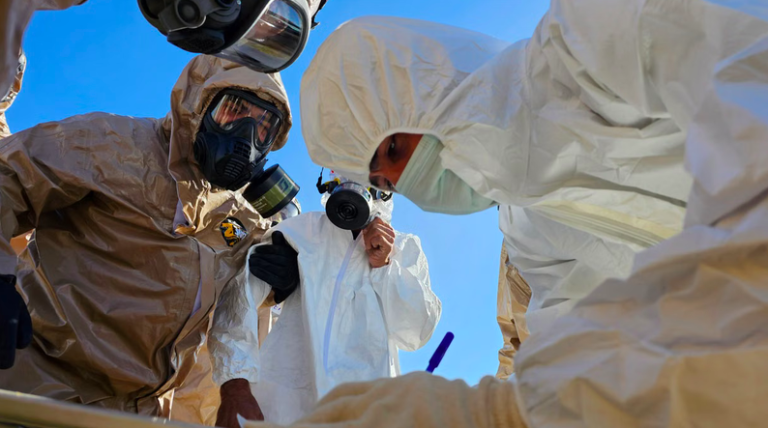
The human toll of the crisis is laid out in granular detail. As of mid-August, the Bundibugyo Ebola strain had killed 2,325 people and infected nearly 5,000, according to figures in the report, the worst outbreak in DRC history, concentrated in Ituri province. At Nyankunde hospital, chief doctor Désiré Duabu told National Public Radio, as cited in the article, that eight of his staff had contracted the virus, including a medical student who died, adding: "It takes a lot of courage to care for the sick. But of course, we do it."
The piece documents a health workforce effectively abandoned by the state: frontline doctors and nurses in Ituri say they have gone unpaid since the outbreak was declared in mid-May, prompting walkouts and protests by early August. Physicians for Human Rights, interviewing staff in July, found surveillance missions frequently could not proceed "because of a lack of resources." Mercy Corps, meanwhile, recorded 68 security attacks on the Ebola response between mid-May and July 1.
Against this backdrop, the article notes, Tshisekedi traveled with an extensive entourage to the Champions League final in Budapest on May 30 and to Houston on June 17 for DR Congo's World Cup opener against Portugal, even as the WHO convened an emergency Ebola session in New York.
Domestically, van Niekerk and Misser report, Tshisekedi is maneuvering toward an unconstitutional third term; courts have upheld most of his workaround of term limits but rejected a provision allowing him to call a referendum without parliamentary approval. Opposing him is the C64 coalition — uniting Martin Fayulu, Katumbi and Delly Sesanga with churches and civil society — described in the piece as the broadest anti-Tshisekedi front since he took office. Elections set for 2028 face uncertainty after a fire last November destroyed the national electoral commission's printing equipment and data center in Kinshasa.