(AfriquesPlus) - Joakim Noah spent 13 years in the NBA, but the game still shapes how he sees the world. In the ninth episode of NOMAD, titled "Joakim Noah Finds the Future of Basketball in Senegal" and published on YouTube, he goes back to a country he has visited since childhood, when his mother first brought him there. The series, which Sports Illustrated reports is co-produced by the NBA and Take-Two Interactive under the NBAT2 Media banner, has him travel the world to see what basketball means in different cultures.
Noah, who says he has "roots on this continent," frames the trip around a shift he noticed. He has spent his life watching great African players leave to find opportunities elsewhere. In Senegal, he says, something bigger is now taking shape.
His first stop is Dakar, with designer and entrepreneur Adama Paris, the woman behind Dakar Fashion Week. She tells Noah she was a banker who got fired, which she now calls a favor. She returned to Senegal and founded the event, which she says has created more than 600 jobs. It has since traveled to Congo, Gambia and Angola. The episode credits her with dressing Beyoncé and bringing Pharrell Williams to Senegal for a show. She tells Noah that Senegalese who travel abroad usually do so intending to come back.
Noah then gathers Adama and Amadou Gallo Fall, president of the Basketball Africa League (BAL). Fall has spent his life using basketball to create opportunities in Africa. He speaks of writing "another chapter" in the growth of the sport on the continent. Noah describes him as someone who sees basketball as a tool for something much larger than a game.
Gorée Island: facing the past
Before trying to understand Senegal's present, Noah says he had to return to Gorée Island, a site tied to the Atlantic slave trade. A local man he calls "Rasta" tells him the island draws 800,000 visitors a year and that schools across Senegal bring their pupils. He argues that painful history must be remembered because it is part of the country's culture. Losing that culture, he says, means the roots of the tree can never grow.
Inside the House of Slaves, Noah describes how as many as 150 to 200 people could be held at once, chained and treated as merchandise, with families separated by buyers. Then comes the "door of no return." A guide tells him the door's design has been reinterpreted for today: it is now meant as a "door of return" for the Black diaspora.
Over lunch, Adama and Fall try to explain what makes Senegal distinctive. They point to the humility and welcome of the people, and above all to giving back. They describe childhoods in households that included people who weren't biological relatives, and say acquaintances easily become family. Noah highlights the Senegalese word teranga, the idea that what you have isn't only for you, illustrated by families eating from a single bowl. Fall argues that the country has abundant wealth and talent, and that the task is to turn it into something that serves society as a whole.
The basketball heart of the episode is SEED Academy, where the acronym stands for Sports for Education and Economic Development. Fall founded it more than 20 years ago on a former French military training base, starting with a small group of kids and an idea. The academy's values, including self-reliance and being mission-driven, are written on a tree on the grounds.
Noah says he can see how much has changed since his earlier visit, with more kids, more facilities and more opportunities. The model rejects the old pipeline. Rather than sending one or two players a year to the United States, Fall says, the idea was to bring them all to one place at home. Basketball is only the entry point: a student tells Noah the early days were hard, but that he now speaks good English and is preparing for college. Noah calls it the only sustainable basketball academy on the continent. Being around Fall, he says, makes him ask what he is doing with his own roots.
Off the grid in a baobab forest
Noah also visits his sister's childhood best friend, who returned to Senegal after living in some of the world's biggest cities. She and her husband now live off the grid in a baobab forest, in a house built from laterite rock, powered by solar panels and supplied by their own well. She says the community is working toward a professional borehole so it can grow its own food, which she calls the last step toward autonomy. Noah shares her belief that the roughly 500-year-old baobabs have something mystical about them. He concludes that in Senegal you don't have to choose between the past and the future.
Back in Dakar, Noah watches traditional wrestling, a sport he says has drawn massive investment and produces stars like Modou Lo. Young fighters look up to Lo the way basketball players look up to Michael Jordan or Derrick Rose. Wrestling, a local says, is no longer just for fun: it can feed a family and support a long career.
Noah is struck by the sight of so many people training on one beach at sunset. He compares the wrestlers' year-round beach routine to basketball players who are always either in the gym or on the court. A local explains that Lo helps the next generation financially and with training. Before his last fight, he took 17 wrestlers with him to France to work out. The ambition, Noah is told, is to dominate wrestling around the world.
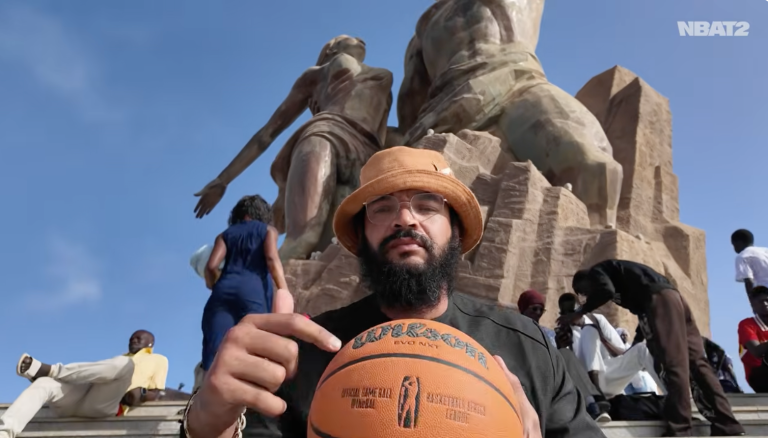
The trip closes at the African Renaissance Monument, which Noah reaches by car rapide, the colorful minibuses Dakar residents use to get around. A guide explains its symbolism: the child points toward a new future, the mother tells the father they can follow, and the father is warned not to forget their roots, or the future will be very dark.
From the monument, Noah spots a basketball court, and he heads down to play with local kids. His conclusion is that people are building things in Senegal: Adama an industry, Fall an academy and a league, his friends in the forest a new way of life, and Modou Lo opportunities for young wrestlers. The kids can still dream of going anywhere in the world, he says, but leaving doesn't have to be the only path. It is about building from within, so that they don't need to leave Africa to find opportunity.