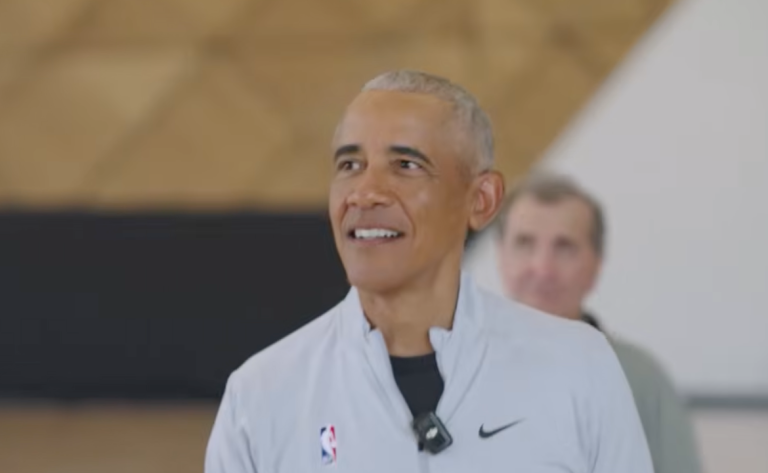
(AfriquesPlus) - Former U.S. President Barack Obama sat down with retired NBA players Matt Barnes and Stephen Jackson, hosts of the podcast All the Smoke, for an unusually personal conversation filmed inside the brand-new gymnasium at the Obama Presidential Center on Chicago's South Side. The episode, described by the hosts as a milestone for their show, ranged from pickup basketball war stories to reflections on race, fatherhood, the NBA Finals, and how Obama has adjusted to life nearly a decade removed from the presidency.
The conversation opened with Obama and the hosts shooting around on the Center's new court, what Obama called its "christening." Asked whether he cheated during pickup games the way Magic Johnson was famously known to, Obama laughed off the comparison but admitted the games got physical. He recalled a long-running White House tradition of playing full-court basketball on every Election Day, including in 2016, when he said he was "raining down threes" before instinctively worrying the good fortune would cost him later.
He also revisited a well-known anecdote from his presidency: getting split open during a pickup game over a Thanksgiving weekend and needing stitches, an injury that became internet fodder at the time. Obama said he had the sequence of photos from that day framed and gave a copy to the staffer he blamed for the elbow, inscribing it as a joke to "the only man who ever assaulted the president and got away with it."
Much of the interview centered on Obama's motivation for locating his presidential center in the Chicago neighborhoods where he began his career. He described arriving in the city at 25 years old, hired by a coalition of churches for $13,000 a year to do community organizing in areas hollowed out by steel-plant closures. That same stretch of the South Side, he noted, is where he met Michelle Obama, where the couple held their wedding reception, and where their daughters were born.
Obama said the goal behind the Center was to use the pull of a presidential library to build something more useful for the community: a facility combining a full basketball court, a Chicago public library branch, art galleries, and a recording studio aimed at exposing local kids to career paths in sports, music, and the arts, not just as spectators, but with access to industry professionals who could show them opportunities beyond playing professionally.
On Race, Identity, and Being Biracial
Turning personal, Obama described growing up in Hawaii largely without his father, whom he met only briefly around age 10. He credited basketball with giving him a sense of belonging during a childhood light on black role models in his immediate environment, saying the sport felt like a meritocracy, "everything's based on can you play", and that he absorbed cues on how to carry himself from watching players like Julius "Dr. J" Erving and Walt "Clyde" Frazier on television.
In one of the interview's more candid stretches, Barnes, who is also biracial, asked Obama whether there was a specific moment he realized the world saw him primarily as a Black man. Obama said Hawaii's uniquely mixed demographics spared him some of the racial sorting common on the mainland, and credited his mother and grandparents with consistently speaking positively about his absent Kenyan father, which he said gave him a foundation of pride in his Black identity rather than shame. He also recalled the first time he brought Michelle to visit his father's rural village in Kenya, where relatives asked which of her parents was white, a moment he described as a reminder that Black American identity absorbs a wide range of influences, "even when you don't realize it."
The trio also dug into basketball analysis, with Obama praising New York Knicks guard Jalen Brunson for the mental toughness and physical endurance he showed leading his team through the playoffs, comparing his impact to that of Stephen Curry and Isaiah Thomas as undersized guards who carried championship-contending teams. Obama also discussed the young San Antonio Spurs core built around Victor Wembanyama, Stephon Castle, and Dylan Harper, suggesting Wembanyama will need to add strength and refine his conditioning as defensive schemes increasingly force him to guard beyond the paint.
Asked about the transition out of office, Obama said his first priority afterward was making up time with Michelle Obama, acknowledging the toll the presidency had taken on their family life. He said he does not miss the formality of the office, but does miss the camaraderie of working under constant pressure with a team, comparing it to the bond athletes describe with teammates or service members with their units.
Staying Composed Amid Political Attacks
He framed his post-presidency work, largely channeled through the Obama Foundation and the Presidential Center, as a shift "from player to coach", focused on identifying and mentoring the next generation of leaders rather than remaining in the spotlight himself.
Pressed on how he manages to respond with restraint to a successor who frequently invokes him, Obama said that during his own presidency he had neither time nor cable news access to fixate on predecessors or critics, relying instead on staff to relay constructive feedback while he tuned out the broader noise. He extended that philosophy into broader advice for young people, warning against letting strangers' opinions on social media dictate one's self-worth or performance, and noting that in his experience, critics rarely say in person what they post online.
Obama said he lacked close personal mentors early in his political career, instead studying historical figures such as Martin Luther King Jr., Abraham Lincoln, Mahatma Gandhi, and lesser-known civil rights organizers like Bob Moses and Diane Nash. He singled out one piece of practical advice as the most valuable he received in politics: from Pete Rouse, a veteran Senate chief of staff who briefly ran Obama's own office after his 2004 election, who told him the most important thing a freshman senator could do was answer constituent mail promptly, ensuring people back home felt looked after rather than forgotten in Washington.
Closing the interview, Obama urged perspective drawn from history, invoking the era of slavery, Jim Crow segregation, and the experience of his late mother-in-law, Marian Robinson, who grew up attending segregated schools on Chicago's South Side. He argued that progress "doesn't move in a straight line," and that individuals can contribute to healing national divisions simply by being good neighbors and setting a constructive example within their own communities.