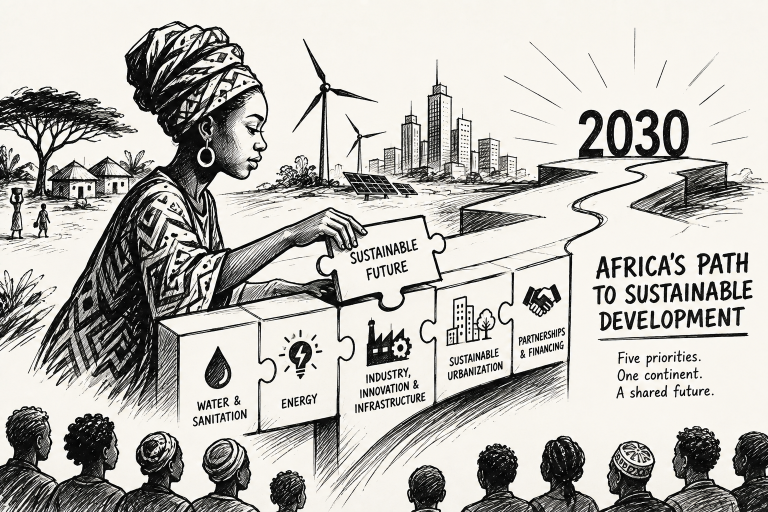
The newly released 2026 Africa Sustainable Development Report, jointly produced by the African Union Commission, the United Nations Economic Commission for Africa (UNECA), the African Development Bank and the United Nations Development Programme, delivers a message that is both sobering and hopeful: Africa is making progress, but not nearly fast enough.
The report is more than another development assessment. It is a strategic roadmap that asks a fundamental question: Can Africa transform itself before 2030, or will the continent once again fall short of its own ambitions?
Progress is real, but insufficient
Contrary to the persistent narrative of stagnation, the report acknowledges that African countries have registered measurable progress across many development indicators since the adoption of the SDGs in 2015. Improvements have been recorded in twelve of the seventeen Sustainable Development Goals, demonstrating that sustained political commitment and targeted investments can produce tangible results.
Yet these gains remain uneven.
Population growth, climate change, geopolitical instability, mounting debt burdens and chronic financing shortages continue to outpace the speed of reform. As a result, Africa remains off track to achieve the SDGs by 2030 under current trajectories.
This is perhaps the report's central warning: incremental change will no longer be enough.
Five priorities that will shape Africa's future
Rather than attempting to cover every Sustainable Development Goal equally, the 2026 report focuses on five strategic pillars that the authors consider essential to Africa's structural transformation.
The first is water and sanitation. Hundreds of millions of Africans still lack reliable access to safe drinking water and adequate sanitation. While progress has been made in expanding access to water, sanitation infrastructure continues to lag behind, particularly in rural communities. Water security is increasingly becoming an economic issue as much as a public health concern.
The second priority is energy.
Although electricity access has improved across much of the continent, Africa still accounts for one of the world's lowest levels of electricity consumption per capita. Renewable energy offers enormous opportunities, but investment remains far below what is required to support industrialization and universal access. The report argues that expanding clean energy is indispensable not only for climate goals but also for job creation and economic competitiveness.
Third comes industry, innovation and infrastructure.
No country has achieved sustained prosperity without building productive industries and modern infrastructure. The report stresses that roads, railways, digital networks, manufacturing capacity and technological innovation must become central pillars of Africa's development strategy if the continent is to compete in the global economy.
A fourth priority is sustainable urbanization.
Africa is urbanizing faster than any other region in the world. Yet many cities continue to expand through informal settlements that lack adequate housing, transportation, sanitation and public services. Urban growth, the report argues, should become an engine of economic transformation rather than a source of growing inequality and environmental stress.
Finally, the report highlights partnerships and financing.
Development cannot be achieved without resources. Yet Africa continues to face declining foreign direct investment, slowing development assistance and limited access to affordable financing. The report warns that official development assistance could decline significantly in the coming years while Africa still represents less than three percent of global trade. Stronger domestic resource mobilization, deeper regional integration and reforms of the international financial architecture are therefore becoming increasingly urgent.
Beyond aid: a call for structural transformation
One of the report's greatest strengths is that it moves beyond the traditional language of aid.
Instead of portraying Africa primarily as a continent in need of external assistance, it frames development as a question of structural transformation.
The challenge is not simply to finance more projects. It is to strengthen institutions, improve implementation capacity, enhance policy coherence and build resilient economic systems capable of withstanding future shocks. This represents a notable shift away from fragmented interventions toward integrated, long-term planning that aligns national development strategies with both the SDGs and the African Union's Agenda 2063.
Climate change can no longer be treated as a separate issue
Another important message running throughout the report is that climate resilience is no longer an environmental issue alone.
Climate change increasingly affects food security, energy systems, infrastructure, fiscal stability and public health. Droughts, floods and extreme weather events are already reversing hard-won development gains in several African countries.
The report therefore argues that climate adaptation should be integrated into virtually every public policy rather than treated as a specialized sector.
Governance remains the missing link
Perhaps the report's most important implication lies between its lines rather than in its statistics.
Africa's development challenge is not simply one of resources. It is also one of governance.
Many African countries possess abundant natural resources, youthful populations and growing technological capabilities. Yet weak institutions, fragmented implementation, bureaucratic inefficiencies and inconsistent public policies continue to undermine progress.
The report repeatedly emphasizes the need for stronger implementation capacity, accountability and better monitoring systems. Development is no longer primarily about designing ambitious strategies. It is about delivering measurable results.
The real race begins now
The publication of the 2026 Africa Sustainable Development Report comes at a pivotal moment.
The conversation should no longer revolve around whether the continent will achieve every SDG by 2030. That objective now appears unlikely.
The more relevant question is whether Africa can use the remaining years to build the institutional foundations that will allow sustained progress well beyond 2030.
History suggests that development rarely follows linear timelines. Countries that ultimately succeed are often those that use periods of urgency to undertake bold reforms.
That is precisely what the report calls for. Not more declarations. Not more conferences. Not more fragmented projects.
But a new generation of coordinated public policies capable of transforming Africa's immense demographic, natural and entrepreneurial potential into inclusive and sustainable prosperity.
The next five years may not determine whether every Sustainable Development Goal is achieved.
They may determine something even more important: whether Africa finally shifts from managing development to driving it.