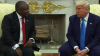
As the world watches conflicts unfold in Ukraine, the Middle East and parts of Africa, another democracy is entering dangerous territory. Colombia, long regarded as one of Latin America's most resilient electoral democracies despite decades of internal conflict, is now confronting a political crisis that could test the very foundations of its institutions.
Just days before leaving office, outgoing President Gustavo Petro issued one of the strongest warnings ever made by a departing Colombian head of state. He claimed that the presidential election won by conservative lawyer Abelardo de la Espriella was marred by massive electoral fraud and warned that the country could slide toward civil conflict if the institutional crisis is not resolved. According to Petro, the alleged fraud was "systematic" and involved large-scale algorithmic manipulation of votes, although he has yet to make public the evidence he says he possesses. His successor has firmly rejected those accusations, and Colombia's electoral authorities have officially validated the results.
Whether Petro's allegations prove true or not, they highlight a much broader issue that extends far beyond Colombia: what happens when political actors lose confidence in the institutions responsible for certifying elections?
A deeply polarized transition
Abelardo de la Espriella, a political newcomer backed by Colombia's conservative right, narrowly defeated Petro's political ally, Senator Iván Cepeda, in June's presidential runoff.
His inauguration is already breaking with tradition. Rather than taking place before Congress in Bogotá, the ceremony will be held in Cali, while opposition lawmakers have announced a boycott and called for demonstrations in several major cities.
The symbolism is powerful.
Transitions of power are supposed to reaffirm democratic continuity. Instead, Colombia is preparing for an inauguration under the shadow of institutional distrust, competing narratives and growing social tensions.
The dangerous erosion of electoral legitimacy
Throughout modern history, democracies have survived bitter elections because losers ultimately accepted the legitimacy of the institutions overseeing the vote.
That consensus appears increasingly fragile around the world.
From the United States to Brazil, from Romania to several African countries, accusations of electoral fraud have become a recurring feature of political competition. Sometimes they reveal genuine weaknesses in electoral systems. Sometimes they reflect the refusal of defeated political forces to recognize legitimate outcomes. In both cases, however, the cumulative effect is the same: public confidence in democratic institutions gradually erodes.
Colombia may now be entering this perilous cycle.
When an outgoing president openly describes his successor as "illegitimate," the debate moves beyond ordinary political disagreement. It becomes a question of institutional survival.
Violence remains Colombia's unresolved challenge
Petro's warning cannot be understood without considering Colombia's long history of political violence.
For more than half a century, the country has endured armed conflict involving left-wing guerrillas, right-wing paramilitary groups, drug cartels and criminal organizations. Although the landmark 2016 peace agreement with the FARC significantly reduced large-scale hostilities, violence never fully disappeared.
In recent years, several armed groups have re-emerged or expanded their territorial control. Illegal mining, drug trafficking and organized crime continue to finance violence in many regions. Petro's ambitious strategy of negotiating simultaneously with multiple armed organizations produced only limited results, while security conditions deteriorated in several parts of the country.
Against this backdrop, political instability carries far greater risks than it would in many other democracies.
International dimensions
The crisis also has an important geopolitical dimension.
During the campaign, President Donald Trump openly expressed support for Abelardo de la Espriella, whose platform emphasized restoring security through tougher law enforcement and a more confrontational approach toward armed groups.
Petro, by contrast, has accused Washington of interfering in Colombian politics and has even suggested that his successor could seek his extradition to the United States on politically motivated charges.
Whether such fears are justified remains uncertain. Yet they illustrate how domestic political disputes increasingly intersect with international rivalries, making national crises more difficult to contain.
Lessons for Africa
At first glance, Colombia's political turmoil may appear far removed from African concerns.
In reality, the parallels are striking.
Across Africa, electoral commissions, constitutional courts and supreme courts are frequently called upon to arbitrate highly contested elections. In many countries, political stability depends less on who wins elections than on whether the losing side believes the process was credible.
This is why institutional credibility matters so profoundly.
Democracy cannot rely solely on ballots. It also depends on trusted referees.
Once those referees lose legitimacy, every election risks becoming merely the first stage of a prolonged political confrontation.
Beyond Colombia
It would be premature to conclude that Colombia is heading toward civil war.
The country's democratic institutions remain intact, and political rhetoric often exceeds political reality during periods of intense polarization.
Nevertheless, Petro's warning reflects a deeper global trend.
Increasingly, elections are no longer ending political disputes. They are becoming the beginning of new institutional crises.
For democracies everywhere—including those across Africa—the Colombian case offers an important reminder.
Political stability ultimately rests not only on constitutional rules but also on a shared willingness to accept institutional outcomes, even when they are politically painful.
Without that consensus, democracy itself gradually becomes another arena of conflict.
And once every election is perceived as existential, every transfer of power carries the potential for confrontation rather than reconciliation.
That may be the most important lesson emerging from Colombia today—not only for Latin America, but for democracies around the world.