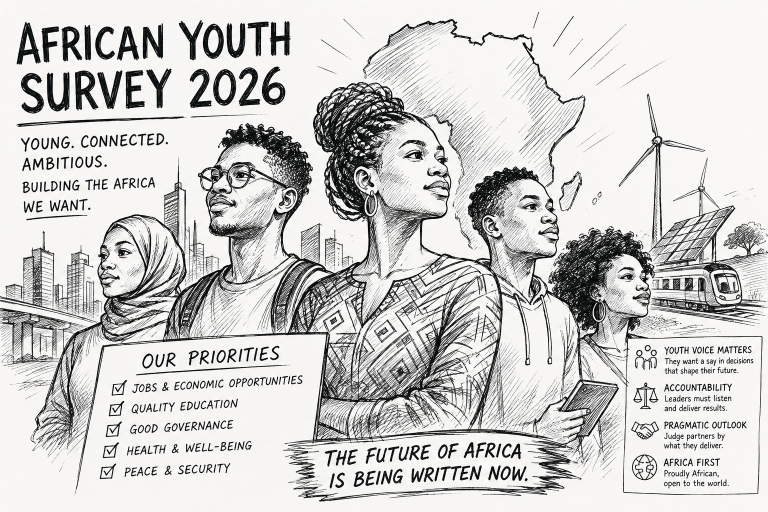
(AfriquesPlus) - Africa's youth have delivered a message that should resonate far beyond the continent. Contrary to many assumptions, they are not turning away from democracy. Nor are they embracing authoritarianism. What they are rejecting is the widening gap between democratic promises and everyday realities.
The newly released African Youth Survey 2026, one of the continent's largest recurring opinion studies, offers a nuanced portrait of nearly 5,000 young Africans aged 18 to 24 across sixteen countries. Rather than portraying a generation defined by frustration or ideological polarization, the findings reveal a cohort that remains remarkably optimistic, pragmatic and determined to shape Africa's future on its own terms.
That distinction matters.
For years, discussions about Africa's demographic boom have focused almost exclusively on numbers. By 2050, one in every four people on Earth will be African. Yet demographics alone do not determine history. Ideas, expectations and political aspirations do. This survey offers one of the clearest windows yet into how the continent's next generation thinks.
Democracy is not the problem
Perhaps the survey's most striking finding is that roughly three quarters of respondents still prefer democracy to non-democratic alternatives. That should dispel the simplistic narrative that African youth are abandoning democratic values.
But support comes with an important qualification.
More than half of those surveyed believe that Western-style democracy is not well suited to Africa's realities. This does not necessarily represent a rejection of democratic principles. Rather, it reflects dissatisfaction with political systems that often deliver elections without accountability, constitutions without effective institutions and freedoms without meaningful economic opportunity.
Young Africans appear to be asking a deeper question: What is the value of democratic procedures if they fail to improve people's lives?
They envision what the survey describes as an "African-style democracy," one grounded in free elections but also in competent leadership, national cohesion, public services and job creation. Their definition is less ideological than functional. Democracy is judged not only by how leaders come to power, but by what they accomplish once they are there.
Jobs are the continent's first security policy
Another important lesson emerges from the survey's treatment of security.
For many governments, security remains largely associated with military spending, counterterrorism or policing. Young Africans see matters differently. They overwhelmingly identify unemployment and poverty as the greatest threats facing their communities and rank job creation as the most effective way to strengthen national security.
This perspective deserves careful attention.
An unemployed generation is more vulnerable to political manipulation, criminal networks, forced migration and violent extremism. Employment, therefore, is not simply an economic indicator. It is a cornerstone of democratic resilience and long-term stability.
The message is unmistakable: economic inclusion is national security.
A pragmatic rather than ideological generation
The survey also paints a fascinating picture of how African youth view the changing international order.
Unlike previous generations whose geopolitical outlook was often shaped by Cold War alignments or post-colonial loyalties, today's young Africans appear strikingly pragmatic. They evaluate international partners less by ideology than by tangible results.
Infrastructure, investment, technology transfer and respect for African interests matter more than rhetorical commitments. This helps explain why China continues to enjoy exceptionally positive perceptions among many respondents while Russia has gained influence in parts of the continent. At the same time, the United States remains an important actor, though its image has become more complex amid changing foreign policy and aid priorities.
This is not necessarily evidence of geopolitical realignment. It is evidence of geopolitical maturity.
Young Africans increasingly appear willing to work with whoever contributes most effectively to their countries' development.
Leaders who listen or risk losing legitimacy
One of the survey's most revealing contradictions is that many young Africans believe they can influence political change, yet an even larger majority believe their leaders remain disconnected from their aspirations.
This gap between civic confidence and institutional responsiveness could become one of the defining political challenges of the coming decade.
The continent's youth are not demanding symbolic representation. They want meaningful participation in public decision-making. They broadly support reforms such as greater youth representation in government, presidential term limits and stronger accountability mechanisms.
Governments that treat youth merely as campaign audiences may find themselves increasingly out of step with a generation that expects to help shape policy rather than simply endorse it.
Beyond Afro-pessimism
The survey also challenges another deeply rooted narrative: that Africa's youth are overwhelmingly pessimistic about the future.
On the contrary, optimism has rebounded to its strongest level since the COVID-19 pandemic, despite continuing concerns about inflation, unemployment and governance.
This optimism is neither naïve nor unconditional.
It reflects a generation that recognizes Africa's immense potential while demanding institutions capable of translating that potential into shared prosperity.
That combination of hope and high expectations may ultimately prove to be one of the continent's greatest strategic assets.
A generation redefining Africa
The 2026 African Youth Survey is more than another opinion poll. It offers a glimpse into the political culture of the Africa that is emerging.
Its respondents are not asking the world to choose between democracy and development. They want both.
They are not rejecting global engagement. They are insisting that international partnerships serve African priorities.
They are not demanding perfection from their leaders. They are demanding competence, accountability and results.
In many ways, the survey suggests that Africa's next generation is moving beyond the ideological debates that have long dominated both domestic politics and international perceptions of the continent.
Their message is refreshingly simple. Judge governments by what they deliver. Judge partnerships by what they build. Judge democracy by whether it improves people's lives.
If African leader band Africa's international partners fail to hear that message, they may soon discover that the continent's youngest generation is also becoming its most influential political force.