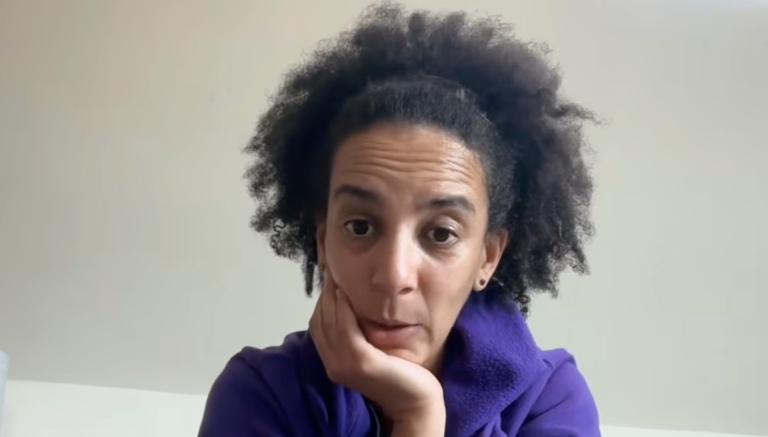
(AfriquesPlus) - She has spent over a decade warning that the gravest danger of this technology was never the machines themselves, but the people selling them. Days before receiving the Right Livelihood Award, often called the Alternative Nobel Prize, computer scientist Timnit Gebru told DIE ZEIT why she still refuses the industry's doomsday narrative.
In the interview, conducted by journalist Eva Wolfangel for the German weekly, Gebru, co-author of the landmark 2021 paper that branded large language models "stochastic parrots," and former co-lead of Google's AI ethics team, which she left in 2020, said watching her warnings prove true brings her no satisfaction. Rereading a text she wrote in 2015, she found the line still holds eleven years later: "I'm afraid of the men who tell us such things, and who act irresponsibly."
Gebru, now co-founder of the Distributed AI Research Institute (DAIR), argued that AI's developers face no accountability, and that framing the technology as a total exception has convinced lawmakers that no existing laws apply to it. She said OpenAI should instead be treated as a company releasing dangerous software, facing criminal investigation and prosecution, "none of that happens," she told Wolfangel. Pressed on former OpenAI chief scientist Ilya Sutskever's claim, in a 2019 documentary, that it was "quite likely" the planet would one day be covered in data centers as the result of an unstoppable force, Gebru pushed back sharply: "Nothing is unstoppable."
She noted that the same people predicting AI could kill humanity within a decade also promise it will cure every disease, concluding that "the utopian and the dystopian stories are the same." That narrative of an unstoppable, godlike technology, she said, ensures that "no one asks: why do we need this technology at all?", even as data centers drain energy and worsen water scarcity. For Gebru, the actual existential threat is the climate catastrophe such infrastructure accelerates, alongside the exploitation of underpaid data workers who annotate training data under often inhumane conditions: "People talk about superintelligence as if there weren't people laboring over these systems."
Asked about recent AI failures — a chatbot that hallucinated nuclear weapons aboard a Chinese vessel, nearly prompting a US boarding, and a January 2026 airstrike on a girls' school in Iran's Minab based on outdated automated targeting — Gebru called it ironic that the industry still invokes superintelligence after relying on a model that "simply made something up."
She linked AI boosters directly to their funders, citing Jaan Tallinn, an early Anthropic investor who also co-founded the Future of Life Institute and funds METR, the group that audits Anthropic and OpenAI: "That's like Philip Morris funding all the scientists studying what the tobacco industry should do." Framing existential risk in percentages, she added, is itself the problem: "Ten percent probability that humanity goes extinct, that's pseudoscience," a critique she extends to alignment research itself, calling the whole concept "completely ridiculous" for treating AI as an independent being rather than a product people choose to build.
Gebru, who fled Ethiopia as a teenager during wartime, said it took her years to see how companies she worked for — she cited Anthropic's partnership with Palantir, which builds systems used to track migrants in the US — perpetuate the very harms she once fled. That reckoning forms the spine of her forthcoming book, Deep Unlearning: The Radicalization of a Tech Idealist.