(AfriquesPlus) - From the Rwandan army backing M23 to the private military companies hired by Kinshasa, Wazalendo militias and Uganda’s army, the war in eastern Congo has become a criminal ecosystem in which everyone sells force. A report published in September 2026 describes a system that sustains the instability it claims to fight.
Between 6,000 and 7,000 Rwandan soldiers deployed in North and South Kivu as of December 2025, security contracts worth tens of millions of dollars, taxes collected right inside coltan pits: eastern Democratic Republic of Congo has become a place where war pays. That is the thesis of “Violence for Sale,” a report published in September 2026 by Zobel Behalal, a senior expert at the Geneva-based Global Initiative Against Transnational Organized Crime (GI-TOC).
According to Zobel Behalal, the conflict stands out for the “reciprocal outsourcing of violence.” Kinshasa and Kigali alike have handed large parts of their military action to third parties pursuing their own interests. The author sees a vicious circle: by entrusting security to private actors, the state loses control and feeds a criminal economy that those actors have every reason to prolong.
The report recalls that M23 resumed fighting in November 2021. It now controls Goma and Bukavu, the capitals of North and South Kivu, along with several strategic mining sites. The fighting has caused nearly 10 million internal displacements.
Rwandan support for the movement has long been an established fact, Zobel Behalal writes. Kigali denied it for years, but on 22 January 2026 Rwanda’s ambassador to the United States acknowledged “security coordination” with M23. In March 2025, the European Union sanctioned several M23 and Rwandan army leaders, as well as the Gasabo Gold Refinery. The United States targeted the Rwandan army and four of its senior officers, then, in June 2026, the same refinery.
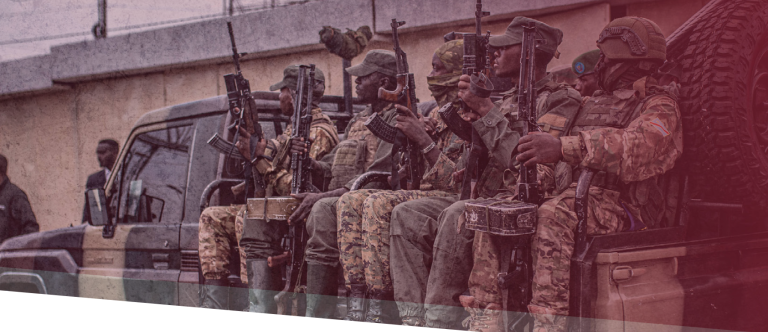
The report highlights the movement’s level of equipment: drones, anti-aircraft systems and electronic warfare tools, including a Chinese Type 92 Yitian system and SA-16 portable missiles. Experts cited by the author believe part of this materiel comes from Rwandan army stockpiles. Such transfers would violate UN Security Council Resolution 1807, which has banned arms deliveries to armed groups in the DRC since 2008.
On the Congolese side, faced with an army described as failing (President Félix Tshisekedi himself spoke in December 2025 of “an army of vagabonds”), private military companies have proliferated. The most prominent figure is Erik Prince, founder of Blackwater. In December 2024, he signed a five-year contract with the Congolese Ministry of Finance, estimated at between US$100 million and US$200 million. Its stated aim is to secure mining sites and improve tax collection.
The author sees an unprecedented model in which military capabilities, civil infrastructure and revenue generation are sold as a package. The report notes that his teams supported Congolese units in Uvira in January 2026 with drone surveillance and technical assistance, even though the contract is not supposed to cover combat zones. Because these agreements fall under the finance and mining ministries rather than defence, no public decree governs this presence, which, in his view, raises questions about oversight and accountability in case of abuses.
The Wazalendo militias, which fight M23 alongside the army, receive weapons, ammunition and payments: one member cited by Zobel Behalal says the government paid US$325 to each fighter in the Fizi and Uvira territories in February 2026. Several of their groups are nonetheless documented for war crimes, and two of their leaders, Guidon Shimiray Mwissa and William Amuri Yakutumba, are under UN sanctions.
Uganda, an official partner of Kinshasa since an agreement signed in June 2025, plays several hands at once, according to the report. Kampala allegedly maintains ties with Thomas Lubanga’s Convention for the Popular Revolution (CRP), active in Ituri, in order to secure access to Lake Albert and its oil stakes. Elements of the Ugandan army are also allegedly involved in the gold trade: Uganda exported US$6.4 billion in gold in 2025, nearly double the 2024 figure, with a significant share coming from the DRC according to the report.
It is in the Rubaya coltan mines, held by M23 since April 2024 and estimated to account for about 15% of global supply, that the report best quantifies this war economy. According to UN estimates cited by the author, the movement collects at least US$800,000 a month in taxes there. Local sources cite US$7 per kilo for buyers, and US$500 to US$1,000 to purchase a new pit.
The ore then travels to Rwanda, where it is mixed with domestic production to hide its origin. National Bank of Rwanda figures show a 110.4% rise in declared volumes between 2022 and 2025, with no new mining operations opened, which the report finds troubling.
Finally, Zobel Behalal describes a capture of the security windfall by Kinshasa’s power circles. A religious adviser, Olivier Chekinah, allegedly acted as a “gatekeeper” between the presidency and foreign providers, taking about 10% of contracts, tens of millions of dollars redistributed through political networks, according to security sources cited in the report.
For Zobel Behalal, the ongoing peace processes (Washington, Doha, Lomé, Luanda) focus on ceasefires and political dialogue and neglect the economic structures that sustain the fighting. He fears the Washington Accords, signed in December 2025, could normalize predatory circuits absent a clear break with them. His recommendations include integrating economic interests into mediation, tighter control of arms and mineral flows, reform of the Congolese army, and a clear legal framework for security partnerships.